Policy Proposal - Summary:Redesigning the "Public Knowledge Circulation" to Restore Democratic Function
A Proposal for Democracy Update Based on Climate Change

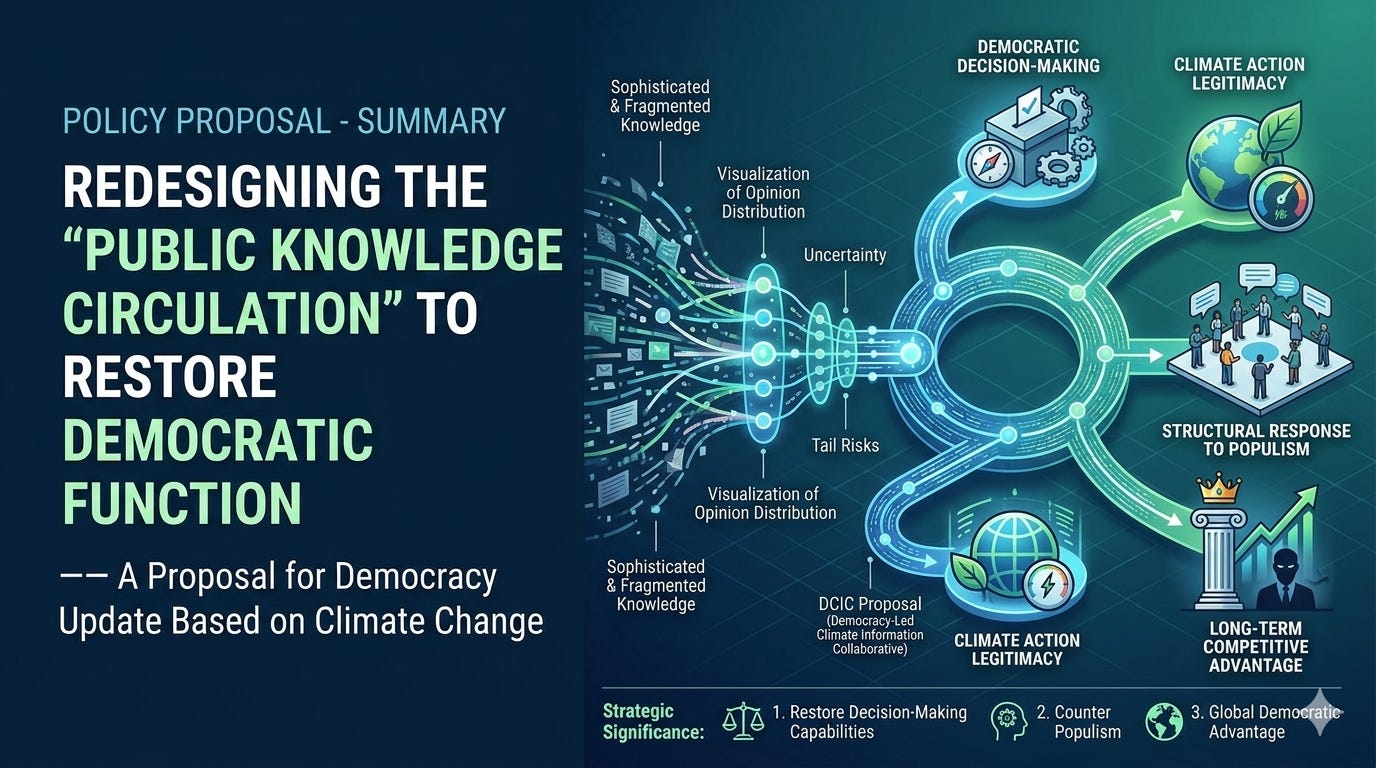
Policy Proposal - Summary
Redesigning the “Public Knowledge Circulation” to Restore Democratic Function
— A Proposal for Democracy Update Based on Climate Change
1. Recognition of the Problem (Key Points)
The crisis currently facing democracies stems not from the failure of the democratic system itself, but from the lack of “knowledge circulation design” in advanced societies.
The following points are particularly crucial:
Scientific knowledge and policy information have become so sophisticated and fragmented, reaching a level beyond the ability of citizens to keep up.
Information has been summarized and simplified, resulting in a lack of shared uncertainty and opinion distribution.
Citizens are formally sovereign, but lack substantive information for making decisions.
As a result,
Democracy’s function as a “decision-making body” has declined, making it relatively inferior to authoritarian regimes.
2. Structural Flaws Revealed by Climate Change
The climate change issue has most clearly exposed the structural flaws of current democracies.
High uncertainty
Extreme impact of tail risks (worst-case)
Long-term, intergenerational, and international impacts
In response to these challenges,
Science communication that only presents conclusions
Designed to persuade citizens
will not ensure democratic legitimacy or effectiveness.
3. Minimum Functional Requirements of Democracy (Proposal)
For democracy to function as a decision-making body, the following minimum functional requirements must be institutionally guaranteed.
Visualization of the distribution of scientific opinions, uncertainty, and tail risks
Systematic organization of extreme event and threshold (tipping) risks
Open infrastructure directly accessible to citizens and policymakers
This is not an add-on measure, but a fundamental infrastructure essential for modern democracy.
4. Proposal: DCIC (Democracy-Led Climate Information Collaborative)
Objective
Democracies will work together to build a minimal public information infrastructure that accurately bridges the scientific exploration space between citizens and policymakers.
Features (Minimum Configuration)
Does not monopolize research
Does not promote a single view
Does not act as a proxy for policy decisions
Roles will be limited to the following:
Organizing the distribution of scientific views
Translating uncertainty and risk structures
Public provision for citizens and policymakers
Does not replace existing organizations such as the IPCC, but will specialize in complementing, translating, and visualizing information.
5. Strategic Significance (Beyond Climate Policy)
The significance of this proposal goes beyond climate change countermeasures.
Restoring democratic decision-making capabilities
Structural responses to populism and anti-intellectualism
Establishing a long-term competitive advantage over authoritarian regimes
The strength of democracy lies not in speed or centralized control, but in its ability to exploratory space.
If we can institutionalize the prerequisite for this—wide information dissemination—democracy can regain its advantage.
6. Conclusion
Climate change is both a crisis and a historic opportunity to update democracy for the 21st century.
Without redefining knowledge as a public good and incorporating it as a core function of democracy, neither a sustainable social order nor the survival of democracy is possible.
This proposal is a minimal and feasible first step toward that goal.
👇 Supplementary explanation :

Top-page :

All-top :
